Saturday, January 26, 2013

Yuma 2

Sunrise at the RV Park
Hello again . . . 
Yes, we're still hanging out with our snowbird friends in Yuma AZ.  We intended to stay for one month (Dec.) to better understand why so many folks spend their winters here.  It didn't take long to figure it out and, when we did, we extended for another month.  There are so many things to do that we're busy every day and most things are geared to the interests of people like us . . . retired empty nestors.  Most folks are here primarily to escape the hardships of northern winters.   Canadians make up the majority of our park.  They are all friendly and happy as clams to be this far from the frozen tundra back home.

Our "Things to Do" list is gradually getting shorter.  We'll try not to cover too much in this chapter of our blog.  We'll pick a few things of interest and add another chapter in a week or so.

Ocean-to-Ocean Bridge
Yuma Crossing:   In the 1800s, thousands of gold seekers and pioneers on their way to California passed through Yuma because this was the easiest place to cross the mighty Colorado River.  A small ferry shuttled people and goods over the river for many years.  Finally, in 1915, the first bridge over the Colorado River was built.  The “Ocean-to-Ocean Bridge”, a one-lane steel structure, is still in operation and is a Yuma landmark, alongside the railroad bridge.
 

Historic Yuma Territorial Prison:   Back in the 1870s, 40 years before Arizona became a state, the southwest had a crime problem and needed a place to put the criminals.  Yuma was chosen as the site of a new territorial prison. 

With labor provided by prisoners, the new adobe prison was opened for business in 1876.  During its brief 33 years of operation, more than 3,000 prisoners, including 29 women, spent time here.  It was closed in 1909 and inmates were moved to a new prison in Florence.

Most of the small cells accommodated six prisoners.  There were no televisions, cell phones (pun intended), carpeting, etc.  However, Yuma prison was a state-of-the-art facility in its time and gained a reputation as the “Country Club of the Colorado”.  The prison offered amenities not found in the city or surrounding areas, such as a clean water system, a sewer system, hot and cold running water and electricity with ceiling fans for summer cooling.  The thick adobe walls were no match for the 115+ degree summer heat.
A typical 6-prisoner cell


The Dark Cell was reserved for the worst offenders and problem inmates.  This cell was hollowed into the rock hillside at the end of a short tunnel.  It was almost totally dark, had no heat or air conditioning, no water or bathroom facilities and no furniture.  It smelled terrible and was not a comfortable place to be.
 

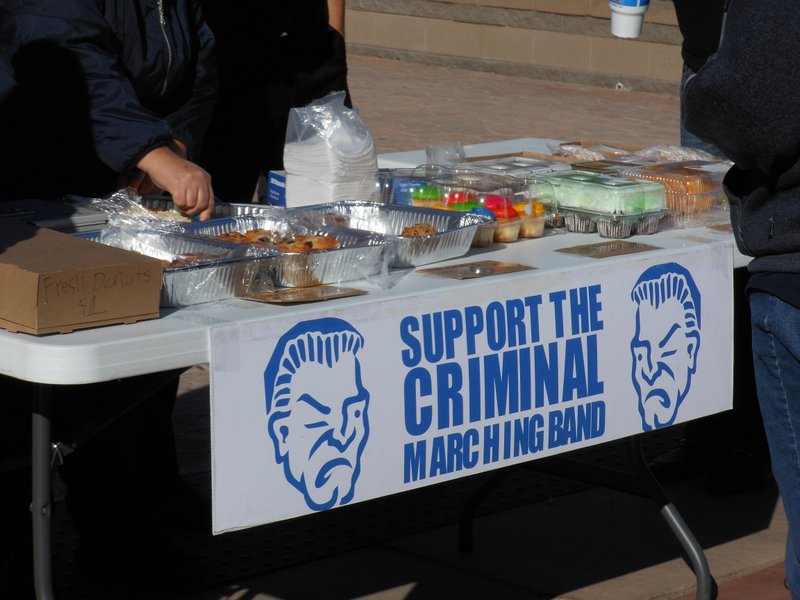
In the early 1900s, Yuma High School burned down.  The prison had recently closed, so the high school moved into the vacant structure and held classes there while the new high school was being built.  During that time, the Yuma football team traveled to Phoenix for a game.  Fans of the opposing team knew they were operating out of the old prison, so they poked fun at them and called them “criminals”.  Yuma won the game and the name stuck.  Today, the Yuma High School mascot continues to be a criminal in striped garb.  During home games, the fans go wild when he is brought into the stadium in a police car with the siren blaring and lights flashing.  During the recent Heritage Festival, supporters were raising money for their Criminal Marching Band.  In Yuma, the "criminal element" is a good thing.
Gathering of the Gunfighters:   For the past 15 years, the Yuma Territorial Prison has hosted this unique event that features period costumes and old west skits.  It’s an historic and often humorous glimpse into the past with confrontations between good guys and bad guys, deciding their issues by shooting it out on Main Street.  It was fun to watch the skits and mingle with old timers from the wild west. 
Gathering of Gunfighters participants
Typical Yumans - 1850 style
Two Guns are Better than One?


Tumco is an easily accessed California ghost town "site" not far west of Yuma.  While most of the town's structures and mining equipment have vanished, it's still a fascinating historic place to visit.  It gets very hot in the summer, so we decided to take advantage of the cool winter weather to visit Tumco before it disappears entirely.


Bonnie hiking to Tumco
Not much left of the town of Tumco

The name Tumco is the acronym for The Union Mine Company. They were mining gold ore. At the height of mining operations the town’s population soared to 3,200 and had the saloons, murders, and a red light district typical of other mining towns. There were dozens of buildings, including a dance hall, the Stingaree Saloon (owned by the town constable) and a grocery store run by Charly Sam, a Chinese immigrant. Tumco didn't last long and, according to historic accounts, it wasn’t a pleasant place to live.
 
Cyanide vats for processing gold
Not much remains of Tumco today.   The old cemetery is still there, as are a few remnants of old buildings and the rusting remains of huge cyanide vats that once separated the gold from the ore and produced gold bars in the final stage of the process.

Foundations from the dismantled mill can still be found and there are lots of old bottles, broken glass and rusted tin cans littering the site.

 
Gold was discovered in this area of the Cargo Muchacho Mountains as early as 1853, and it's possible that the Spanish mined the area long before that. But the mining history is based largely on tales of lost treasures and short on documentation. The most accurate of the tales describes a railroad worker named Pete Walters who discovered "mica schist heavily laced with gold" in this area. Prospectors began pouring into the area in the early 1880’s and established the tent city of Gold Rock Camp, which later became Tumco.


Imperial Sand Dunes Nat’l. Recreation Area:   Not far from Tumco and along the east side of California’s Imperial Valley lies the largest inland sand dunes in the U.S.  We drove out to the small dusty town of Glamis to view the dunes and play in nature’s huge sandbox.  A few dunebuggies were climbing up and down the dunes.

We did a little climbing of our own . . . without a motor vehicle.  That's Bonnie getting near the summit.

The dunes were very impressive.  Fortunately, not all of the area is open to motorized recreation.  The North Algodones Dunes Wilderness Area, beyond the highway in the photo below, is being protected in its natural state.


Farm Tour:   Near the town of El Centro, the Univ. of Calif. operates its Desert Research and Extension Center.  This 255 ac. complex raises crops and cattle and conducts extensive research in areas of agriculture and the desert environment.  One of their outreach activities is agricultural education through the “Farm Smart” program.

We drove over to El Centro one day and took the Farm Tour.   It turned out to be much more than we had anticipated.

Greenhouse
After a lecture, video presentation and greenhouse tour, we were treated to an excellent lunch of salad, fresh from the farm.  Then we climbed onto hay-wagon trailers behind antique tractors, for a tour of the farm.
Farm Tour behind a 1953 Massy Harris tractor
Friends Dave, Dorothy, Dick and Arlene also enjoyed the Farm Tour

At the end of the tour we were invited to help ourselves to a large variety patch of vegetables.  We walked through the rows of cauliflour, broccoli, lettuce, Napa lettuce, beets, radishes, etc., and picked a nice variety to take home.

Bonnie is knee-deep in the veggie patch

Before leaving the farm, we were treated to ice cream in souvenir mugs while listening to some down home style fiddle tunes played by our hosts.  It was a terrific day on the farm.


Quartzsite – the Main Event:   Many RVers looking for a little winter excitement head for the small desert town of Quartzsite AZ in January and February.  Thousands of travel trailers, campers and motor homes arrive from all directions and claim their camp site in one of the many RV parks or camp for free on the BLM lands surrounding the city.  
The Desert Boondockers near Quartzsite

Hundreds of vendors set up their tables and tents to buy, sell and trade just about everything at the “Main Event”.  We did a day-trip to Quartzsite on a cool cloudy day with friends Dave and Arlene to check it out.  For several hours, we wandered through the maze of buildings and tents looking at the amazing array of “stuff”.  
This huge tent is crowded with vendors and shoppers

We bought an interesting stove-top grill and Bonnie found a style of jacket that she had been looking for.  We also collected a bag full of informational brochures, picked up some free ballpoint pens, had a concession stand lunch and topped it off with a huge bowl of ice cream.

Dining at one of the many fine restaurants in Quartzsite

The “Main Event” is the first of many Quartzsite activities.  It’s followed by the “Tyson Wells Sell-A-Rama” which features gems, rocks, minerals, lapidary, precious metals, silver and goldsmithing.  Then there’s the “Vacation and RV Show”, the “Quartzsite Improvement Assn. Pow Wow”, the “Arts and Crafts Fair”, the “Rock and Roll Classic Car Show”, “Hobby and Gem Show” and others.  When it’s all over, the place empties out and returns to being just a small dusty town in the desert.

Mexicali Expo:   Mexicali, Baja California, is a city of nearly 700,000 people just an hour’s drive from Yuma.  A one day festival (Expo) was held at the Yuma Civic Center to promote tourism and inform people of the many services and activities offered in the Mexicali area.  It was a colorful event with nearly two hours of Mexican music and dancing from different states of Mexico.  Very entertaining.

And that's about the size of it for this time.  We'll probably be leaving for home in early February.  This is a happy colorful place to spend time in the winter and we'll miss Yuma and the people we've met here when it comes time to leave.  But, we have business to take care of at home.  Maybe we'll come back next year. 

Sunday, December 23, 2012

Winter in Arizona

Nearly a month has passed since our last blog entry from Las Vegas.  We hope you're still on board.  We waited to see if the world was going to end this month.  Now that it's clear that the Mayans miscalculated and the world is still alive, we'll add another page to the blog to let you know where we are and what we're doing.

We departed Las Vegas on November 27 and drove south to Quartzsite, Arizona.  It's an interesting spot of desert that comes alive with the arrival of thousands of RV "snowbirds".  We arrived early to take a close look at the many campgrounds, RV parks and miles of BLM land around Quartzsite where visitors from the frigid north claim a patch of ground to park their trailers and motor homes for the winter.  A very large gem and mineral show and flea market take place in January, so Quartzsite is the place to be (or to avoid) at that time of the year.  We hope to experience that event next month, so stay tuned.
Sonoran Desert and hills east of Yuma

After a couple days in Quartzsite, we continued down Hwy. 95 to Yuma, our ultimate destination.  Many of our  friends spend their winters in Yuma and urged us to give it a try.  So, we decided to do just that.  We always wondered why anyone would want to spend any time in Yuma, much less several months sitting in a recreational vehicle in an arid sandy desert amongst the scorpions and cacti.  There must be more to it than that.
We parked the motor home on Janet's property for the first week.  Janet is Bonnie's ex-sister-in-law.  After many years of cold wet Washington winters, she decided to buy some property with a manufactured home and become a full-time resident of Yuma.  Her property has separate RV hook-ups which made it very convenient and comfortable for us.

Janet lives in the Foothills, a large residential neighborhood about ten miles east of Yuma. Neighborhoods in this area are designed primarily for RVs. The streets are wide, lots are large and typically enhanced with colorful Mexican brick walls, nice paving, ironwork and desert landscaping.   Many residents park their motor homes on their lots in the winter and go home during the hot summer.  Others make the transition to a "park model" (small casita type dwelling), a manufactured home or a full-size conventional stucco home. It's a fascinating concept that seems to work very well here. 


A cold front moved over Yuma on Dec. 18
After settling in, we began exploring the area and learning about local history, which is always fascinating.  Yuma was listed in the Guiness Book of Records as the sunniest place on earth, averaging 340 days of sunshine per year.  With few cloudy days and less than 3 inches of rainfall, it's no wonder that nearly 100,ooo sun worshipers flock to this area in the winter and occupy about 23,000 RV sites.   It's also no wonder that most of them go home in the spring when the temperature begins to rise.  Summer temperatures often climb to well over 100 degrees in June, July, August and September (record high is 124).  It's not likely that you'll find us here in the summertime. 


Yuma lies in an arid desert environment, but it also has fertile soils, water and a good system of canals for the irrigation of farmlands.  Agriculture is the primary industry and busloads of farm workers cross the border every day to work in the fields.  Yuma County provides 90% of the world's winter lettuce, ranks third in the nation in vegetable production and ranks first in the production of lemons, tangerines, watermelon and cantaloupe.  They also grow corn, cotton, broccoli, cauliflower and other crops.  It's nice to be able to buy fresh veggies at local farmers markets or pick fresh oranges and grapefruit right off the trees.


The Mexican culture is alive and well in the Yuma area and the influence is everywhere.  Wally and Lois, a couple friends from the Bellingham area, took us over the border to Los Algodones one day.  We haggled with the street vendors and had a nice Mexican lunch (huge margaritas) at a central outdoor restaurant.
Los Algadones, Mexico
Lunch with Lois and Wally
Downtown Los Algadones is very close to the border and everything is within easy walking distance.  We first encountered the sidewalk vendors selling nearly everything with especially great deals on belts, wallets, hats, handbags, jewelry, etc.  Most of the buildings are occupied by  dentists, optical shops, drug stores and liquor stores, ready to meet the needs of American and Canadian visitors.  We both needed new perscription sunglasses, so we stopped at a small shop that Wally recommended and, in less than three hours, had new glasses at a fraction of what we would have paid at home.

Bonnie gets fitted for her new Mexican sunglasses.
We've met many travelers who get all their dental and vision work done in Algodones and say the results are excellent.  Dentists advertise very low prices for fillings, crowns, bridges and implants.  A cleaning costs as little as $20 and they do a lot of business.

We hadn't been home since July and wanted to be sure our house and family were okay.  So, Bonnie decided to fly home for a week to take care of some business and visit the family.  She took a shuttle bus to Phoenix to catch her Alaska Airlines flight and Ron picked her up in Phoenix a week later and had a leisurely drive back to Yuma.

While Bonnie was home, Ron was chowing down at the annual Tamale Festival in the small town of Somerton.  Thousands of people attended the festival, listened to live music, watched a tamale eating contest and sampled some of the 40 different types of tamales that were available.  It was a fun event and the food was excellent.
Tamale Festival in Somerton, Arizona


Lots of cooks serving thousands of tamales

In early December, we moved a few miles from Janet's property into Cactus Gardens RV Park. Our intent was to sample the social aspects of being a snowbird in Yuma, and the RV parks are where the action is. We soon found that our park, and most others, are very friendly and offer a full menu of daily activities of all kinds to keep everybody busy. We'll write more about those activities in our next blog.
As Christmas approaches, most RVs in our park are decorated with lights and trimmings. We've seen a couple lighted vehicle parades and our park's golf cart parade was excellent. We don't own a golf cart but it was fun watching the carts, quads and even a decorated and lighted bicycle. It may seem a little silly, but it's serious business and all about having fun.

Christmas Golf Cart Parade
We found a small artificial tree that fits nicely on our dash and put some lights around the windshield.  It feels like home, but on a smaller scale of course.  Now we're getting ready for the Christmas dinner, church services, New Years party and dance and, of course, Ron is looking forward to the football bowl games. 
We're getting into the spirit of the holiday season and the spirit of Yuma, and we can understand why so many people come here to spend the winter.  It's a whole different world.  We'll be here through January and will explain more in our next blog.
 
In the meantime, wherever you are and whatever you're doing, we wish you all a very . . .
 
Merry Christmas
and
Happy New Year
 

Sunday, November 25, 2012

Still in Las Vegas

Yes, we're still in Las Vegas, but will be moving along soon.  This was our first Thanksgiving with no other family members at the dinner table to share the turkey and stuffing, no dogs waiting for dropped scraps under the table, and none of the familiar chatter about work, kids, school, football and other subjects of conversation.  We missed all that but we did enjoy our Thanksgiving.  We had a very nice dinner at Boulder Station’s Feast Buffet and, as usual, ate way too much.  Unable to walk all the way back to the parking lot, we were forced to rest for a while at one of the many penny slot machines and Bonnie managed to triple her $20 investment and walk away a happy gambler.  It was a very good day indeed.


City Center complex on Las Vegas Blvd.
Las Vegas is a fun place to vacation for three days or three weeks.  It’s impossible to run out of things to see and do . . . and it’s not all about gambling.  As "senior citizens on a fixed income", we were very conservative, played only penny slots, and probably came close to breaking even overall.  We joined the Players Club at most casinos.  In exchange for our email address, they gave us a credit card sized casino card and usually $5 or more in free play.  It’s nice to start off with the casino’s money, but knowing when to walk away is really the key.
There are lots of shows to see, including ventriloquists, comedians, singers, old style burlesque, feather dancers and seven different Cirque du Soleil shows.  Show prices are mostly around $100 per ticket but some of the big name artists demand much more.  Garth Brooks just finished a three-year engagement with his fans paying around $250 to see him.  Country singer Shania Twain rode horseback into town, followed by 40 more horses.  Las Vegas Blvd. had to be closed in the heart of the strip to make her grand entrance possible.

We wanted to see one of the big shows, so we found a discount ticket operation and got some good seats to see the Blue Man Group at the Monte Carlo.  It was a fantastic high tech production with lots of visual effects, comedy, loud music and creative drumming.  We didn’t spend much time on the strip but were satisfied to see the Blue Man Group and the Rat Pack, both good shows.

One of our favorite TV programs is Pawn Stars, which is about the operations of a Las Vegas pawn shop.  The program takes place at the Gold & Silver Pawn Shop.  We stopped by one afternoon to look it over and see what they had to sell.  It’s a fairly small shop but full of interesting items.


Gold & Silver Pawn Shop - (Pawn Stars TV Show)
When the Pawn Stars buy things that need to be fixed or restored, they often send them a few blocks away to Rick’s Restorations, which is another interesting place, and which has become another spin-off TV program.  We got a free tour of the restoration shops and saw some of the items that they brought back to life.
Items for sale at Rick's Restorations

Christmas comes early around here.  Thanksgiving has taken a back seat and many stores have had decorations up for weeks, as in this JCPenny's store.

We saw an advertisement for a Christmas lighting ceremony on Nov. 13, so we went to Ethel M’s Chocolate Factory to check it out.  We took a short tour of the candy-making operation, tasted a sample or two, and walked through the extensive cactus gardens.  Christmas lights were strung all over the garden and most of the cacti.  As darkness approached, visitors were entertained with music and songs until all the colorful lights were lit.  Santa showed up to chat with the little kids and everyone was given a pair of 3-D type glasses that made the lights appear even more spectacular.  This whole thing felt a little premature since it was 70 degrees and still a week before Thanksgiving.  But, it was fun.
Christmas Lights in the Cactus Garden at Ethel M's Chocolates

Electric Chair from Sing Sing Prison
One of the most interesting places in Las Vegas is the National Museum of Organized Crime and Law Enforcement, more commonly known as the Mob Museum.  Located on three floors of a former federal court building, this museum includes an impressive number of photos, documents and artifacts of organized crime in the U.S. and especially Las Vegas, including the restored courtroom where Senator Estes Kefauver held some of the famous hearings on organized crime in the early 1950s.  Las Vegas had more than its share of mobsters and criminals involved in its early days as a gambling destination.

Mob Museum - lots of artifacts from mobsters and gangsters of the past
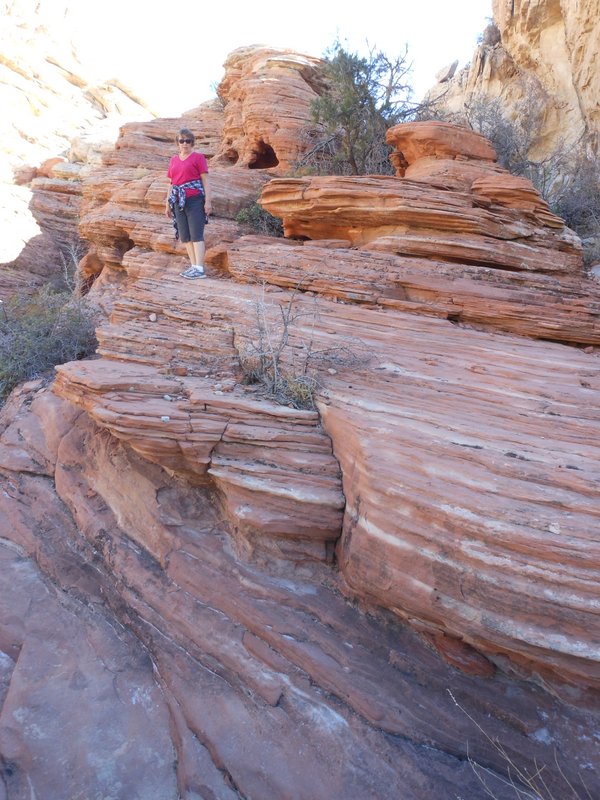
About 20 miles west of Las Vegas is Red Rock Canyon National Conservation Area.  It sounded like an interesting place to visit, so we drove out there and spent the day hiking around the rocks and canyons.

Bonnie on the Rocks

Where the mountains meet the desert in Red Rock Canyon


Fremont Street with video screen canopy
The Fremont Experience is a not-to-be-missed adventure in downtown Las Vegas.  A five-block, 1,500 ft. long section of Fremont Street has been covered with the world’s largest video screen.  It’s 90 feet wide and suspended 90 feet above the street.  After dark each night, 12.5 million LED lights and a 550,000 watt sound system puts on an incredible overhead show.  Between the hourly shows, entertainers perform on three stages, people ride overhead zip-lines, artists paint pictures and many other things are going on all evening.  The Spazmatics (rock music) were playing when we were there.  Spider Man, Elvis, robots and plenty of other “unusual” people wander Fremont to the accompaniment of loud music and flashing neon lights.  It’s definitely a unique experience.
 

We closed out our stay in Las Vegas with a drive over the hill to Boulder City to the Nevada State Railway Museum.  We went for a ride to the summit of Railroad Pass on the historic Nevada & Southern Railway train.
View of hills and desert from the train

After three weeks in Las Vegas, we probably won’t need to return for some time.  It’s known primarily for its night life and gambling, but it also has a more human side.  We found it to be a friendly city (except for aggressive drivers), easy to get around, lots of good shopping, an active university, interesting museums, excellent cultural facilities away from “the strip”, and lots of community organizations working to improve the lives of its nearly two million residents.

And now it's time for us to move on down the road . . .