Saturday, September 15, 2012

Ghost Towns of Montana


It was another warm sunny September day as we cruised from Missoula to Dillon.  The speed limit is 75 mph on most Montana freeways, but there was very little traffic so we were able to cruise along at our usual fuel efficient speed of about 60 mph, enjoying every scenic detail along the way.

Dillon:   During the winter of 1880-81, a railroad town called Terminus was built as an instant “end-of-track” town.  The Utah and Northern Railroad was being built to Butte and this was the end of one segment.  Streets were laid out and buildings erected almost instantly.  The railroad was eventually extended, it later became the Union Pacific, and the town’s name was changed to Dillon.  The community grew to become a business and ranching center, as well as the county seat of Beaverhead County and home of Western Montana College.

Our primary interest in stopping at Dillon was to visit some historic ghost towns in the area.

Bannack was founded in 1862 when gold was discovered on Grasshopper Creek in a remote canyon 25 miles west of Dillon.  The town is celebrating its 150th anniversary this year (2012).  As news of the gold strike spread, thousands of prospectors and businessmen rushed to Bannack hoping to strike it rich.  The town was built quickly and, in 1864, Bannack was named the first Territorial Capital of Montana.  Bannack also had the first hotel in Montana, the first jail, the first school, the first chartered masonic lodge, the first commercial sawmill, etc.

Shortly after the Bannack gold rush, another major gold strike took place on Alder Creek, about 70 miles east.  Many of the miners left Bannack in hopes of finding the mother lode in the new towns of Nevada City and Virginia City.  Along with the miners went the Capital, which was a major disappointment.

Bannack, Montana
 
 
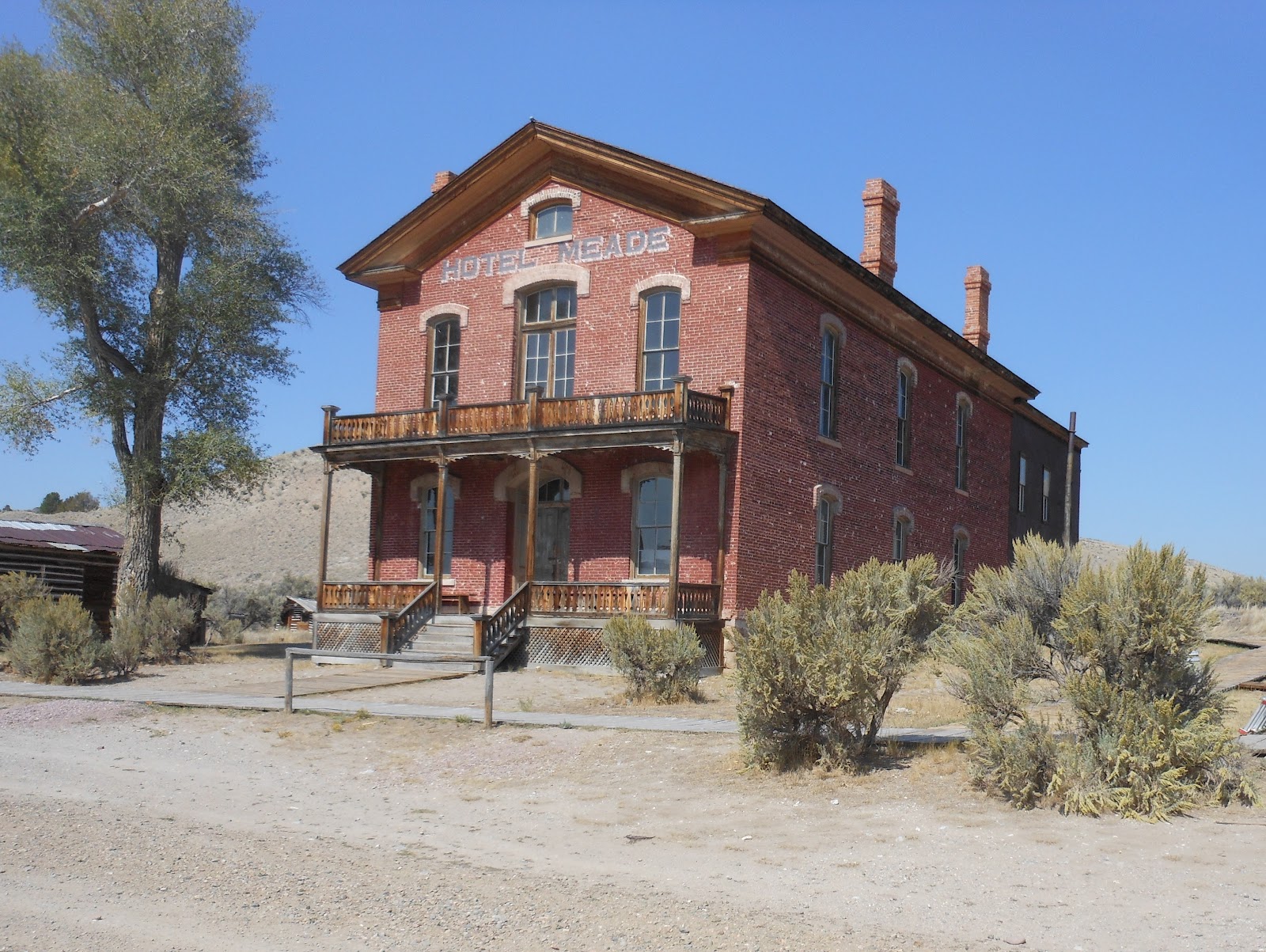
The building beyond the old International truck was built in 1875 as the Beaverhead County Courthouse.  When the railroad arrived in Dillon in 1880, the county seat was moved to Dillon and this building remained vacant for about ten years.
 
In 1891, the old courthouse was turned into the plush Hotel Meade and became the social center of Bannack until the 1940s.
Interior of one of Bannack's un-restored buildings.
Most buildings are just as they were when the town was acquired by the state in 1954.  Old wallpaper, linoleum, plumbing fixtures and sometimes appliances are frozen in time.  Others, such as the bachelor cabins below, couldn't meet the test of time.
 
Hiking up the hill to the original Bannack Cemetery (inside fence)
Not everyone deserted Bannack.  Some stayed to make their homes, run businesses and explore the use of new mining techniques and equipment.  Even the Hotel Meade operated until the 1940s.

From the late 1860's to the 1930's, Bannack continued as a mining town.  However, its population continued to dwindle.  By 1954, most of the gold had been found and most folks had moved on.  At that point the State of Montana acquired the town site and declared Bannack a State Park.
Over fifty structures remain standing today, and most are open to the public.  The state is “preserving” Bannack, rather than “restoring” it.  Roofs are repaired or replaced as necessary to minimize further damage to the most significant structures, and some foundations have been shored up.  Other than that, the buildings are very deteriorated but authentic.

Another unique characteristic of Bannack is the lack of commercialism.  There are no T-shirt shops, coffee kiosks, souvenir stores, etc., and nobody lives there anymore.  Walking down its lonely streets gave us a sense of what it was like 150 years ago in a Montana gold rush town.  Now it’s a real ghost town . . . and there are stories of real ghosts, although we didn’t encounter any.


Virginia City is a National Historic Landmark and considered one of Montana’s premier ghost towns. But, unlike Bannack, it’s also a living community with residents and operating businesses.  It’s considered one of America’s finest collections of old west artifacts and 1860s “boom town” buildings on their original sites.  Most of the old buildings front on Wallace Street (Hwy. 287), while others are scattered around the hilly town.
 

Original storefronts along Wallace Street


Hangman's Building - 5 "road agents" were
 hung in this building in 1864.
A colorful law-and-order story involves Sheriff Henry Plummer of Bannack and Virginia City and his gang of road agents, known as the “Innocents”. They committed more than 100 murders and numerous robberies between the two cities. Finally, a group of Vigilantes took the law into their own hands and hung Plummer and several others. Plummer was hung from the gallows in Bannack and five others were hung at one time from the center beam of a building under construction in Virginia City.   The gallows and the beam are now tourist attractions.


The original Boot Hill Cemetery was used for only a few years.  When the five “road agents” were hung and buried there, most other graves were moved to a new cemetery in 1868.  The road agents’ markers are all that remain at the original site.

When miners were seeking their fortunes, they turned Alder Creek upside down.  Rock and gravel debris piles and tailings can still be seen everywhere along the creek.  It’s a mess!  Today, miners are still working along the creek but not so much for gold.  Now they’re mining garnets and other stones for use in saw blades, sandpaper and other industrial uses.
Mining debris and tailings along Alder Creek

When we returned to Dillon from Virginia City, the smoke from the Idaho and other fires was worse than ever and our eyes were burning.  Mountains surround the Beaverhead Valley, but we couldn’t see them most of the time.  We had a good time visiting the ghost towns, but it was time to move on down the road in search of cleaner air.
Smoky sunset in Dillon

Monday, September 10, 2012

Missoula - Part 2


University Main Hall
University of Montana:   Missoula is home to the Univ. of Montana.  It was founded in 1893 with an enrollment of 50 students.  It has since grown to about 14,000 and the campus is a mix of old and new architecture surrounding the central quad.

 
Ron took a leisurely stroll around the campus on a quiet Sunday afternoon for a closer look at the historic buildings and the large "M" high on Mt. Sentinel.  Although this was his first visit to the campus, he felt a sense of attachment.  His mother graduated from here in 1939, launching her career in music and art education.
Rankin Hall - Originally the first campus library - 1908

The Daly Mansion:   The huge Mustang Fire had been burning in Idaho for more than a month, since July 30.  It had grown to more than 250,000 acres and was beginning to cross the border into Montana.  Its smoke was filling the Bittrroot and Missoula Valleys.  So, what better time than now to take a drive down the valley to the town of Hamilton to pay a visit to the Daly Mansion.

Marcus Daly, one of Montana’s “Copper Kings”, was first involved in gold and silver mining in the Butte area.  One of his mines failed to find gold or silver but hit upon a wealth of copper.  At that time, Thomas Edison was inventing light bulbs and eastern cities were being electrified.  Daly correctly anticipated the future value of copper in electrical applications and established the Anaconda Mining Company, its copper smelter and the town of Anaconda.  He became rich and was earning about $17 million per year, which was a lot of money in the late 19th century.  He used some of that money to build a summer home and 22,000 acre stock farm in the Bitterroot Valley.  The home was known as “Riverside”.

The mansion occupies 24,000 sq.ft. on three levels (plus a full basement).  It has 25 bedrooms, 15 bathrooms and 7 fireplaces, plus several out-buildings and a plunge (swimming pool).

The original structure was a Victorian design.  Following Marcus Daly’s death in 1900, his wife Margaret had the home remodeled into the current Georgian Revival style and lived there.  Following her death in 1941, most of the furniture was sold at auction and the home was boarded up.  It sat vacant for 46 years.
 
It was amazing to learn that, during that time, there was virtually no vandalism and very little deterioration of the structure or its remaining furnishings such as curtains, wallpaper, carpets, etc.  The inlaid hardwood flooring, mohogany woodwork and pocket doors are still there and have been restored.  Also, many of the people who purchased the original furniture and artworks at auction have since returned those items.  [We weren't allowed to take photos inside the home.]
 
Stairway to the rear yard (west side)
Front Yard of Daly Mansion
 

St. Mary’s Mission:  Shining Shirt, a Salish medicine man and prophet predicted, “Fair-skinned men wearing long black robes will teach us a new way of praying and a new moral law.  The Black Robes will bring peace, but their arrival will mean the beginning of the end of all the people who inhabit this land…” 
The “black robes” were Catholic Jesuits, led by Father Pierre DeSmet.  They came, they made friends with the local Indians, and they built St. Mary’s Mission, the first Christian church in the Northwest Territory.  It was built in 1841 in what is now the small town of Stevensville.


Father Ravalli's Grave
Father Anthony Ravalli was among the missionaries who served here.  He was Montana’s first physician, surgeon and pharmacist.  He was also an architect, artist, sculptor and engineer and Ravalli County was named for him.  We visited his grave in the small cemetery behind the mission.


Travelers’ Rest:   A few miles south of Missoula, where Highway 12 leads westward to Lolo Pass, is Traveler’s Rest State Park.  For thousands of years, this location had been a cross-roads (trails) and gathering place for several Indian tribes, including the Spokane, Pend ’Oreille, Flathead and Salish.  In 1805 and 1806, members of the Lewis and Clark Expedition camped here as they searched for easy routes over the mountains.  The Indians helped them and showed them the way.  Following extensive research, it was determined that this is the only archaeologically verified Lewis and Clark campsite in the World.
Site of the only archaeologically verified Lewis & Clark Encampment

Missoula is a very nice community with interesting history and lots to do and see.  It wouldn't be a bad place to live.  Unfortunately, we came here during a period of severe forest fires.  While the University campus is "smoke free", the Missoula Valley certainly isn't . . . at least not this summer.    Hopefully, the air will be cleaner during future visits.
Smoke from the Mustang Fire - Bitterroot Valley and Mountains - September 2012

Missoula - Part 1

Heavy traffic on Hwy. 93 going south past Flathead Lake
Missoula is Montana’s second largest city with a population of about 107,000.  The Salish Indians lived in this area and nearby Hell Gate Canyon was the scene of battles between the Blackfoot, Flathead and other tribes.  Then, along came Lewis and Clark in 1805 (they seemed to be just about everywhere in the West).  Settlers followed, permanent settlements were established and, by the 1870s, the area had a school, a newspaper, businesses and forest and agricultural industries.  However, the settlers were still the newcomers and the native Salish residents weren’t too happy about their presence.  So, to provide added protection from the fear of possible Indian raids, Fort Missoula was established in 1877.  Six years later the city was incorporated, the Northern Pacific Railroad came to town and, by 1889, electricity had arrived and Montana had become a state.  That’s a little history in a nutshell.

Fort Missoula:  This fort was established to protect the settlers from local Indian tribes.  Before it was completed, the commander got orders to turn his attention to a group of Nez Perce Indians, led by Chief Joseph, that was refusing to settle on its assigned reservation.  The soldiers set up a barricade in nearby Lolo Canyon, but the Indians simply went around it and kept going.  The barricade was later called “Fort Fizzle”.  Chief Joseph eventually surrendered near the Canada/Montana border.

Fort Missoula had many uses over the years.  It was a military training center during World War I and the Northwest Regional Headquarters for the Civilian Conservation Corps (CCC) in 1933.  During World War II, it served as an Alien Detention Center and a prison for American personnel accused of war crimes or awaiting court-martial.

An interesting chapter in Fort Missoula’s history involved bicycles.  In 1896, the 25th Infantry Bicycle Corps was organized to test the military potential of bicycles.  The Corps took several fully-loaded trips on bikes, including a very difficult 1,900 mi. ride from Missoula to St. Louis.  It was an impressive test, but the Army concluded that bicycles could never replace horses.  The soldiers of the 25th returned to Missoula by train.

The fort site is now a complex of historical buildings as well as railroad and logging displays.
The one-room Grant Creek Schoolhouse was built in 1907 and later moved to this site.  We remember those blackboards and chalk, the old desks with the ink wells and the flag to which the students pledged their allegiance each morning.  We must be getting old.

This "tipi-burner" was used in 1946 to burn waste from saw mill operations.  Clean air regulations put most of these out of business. Today our air is cleaner and the wood waste is being turned into paper, pressboard and other useful products rather than smoke.
View looking straight up from the middle of the tipi burner.
An old Shay logging locomotive approaches the restored 1910 depot that was moved from Drummond to Fort Missoula in 1982 and restored.


The Sliderock Lookout was removed from Sliderock Mountain and brought to the museum in 1983.  It’s a little shakey, but visitors are allowed to climb the stairs and take a look around. 

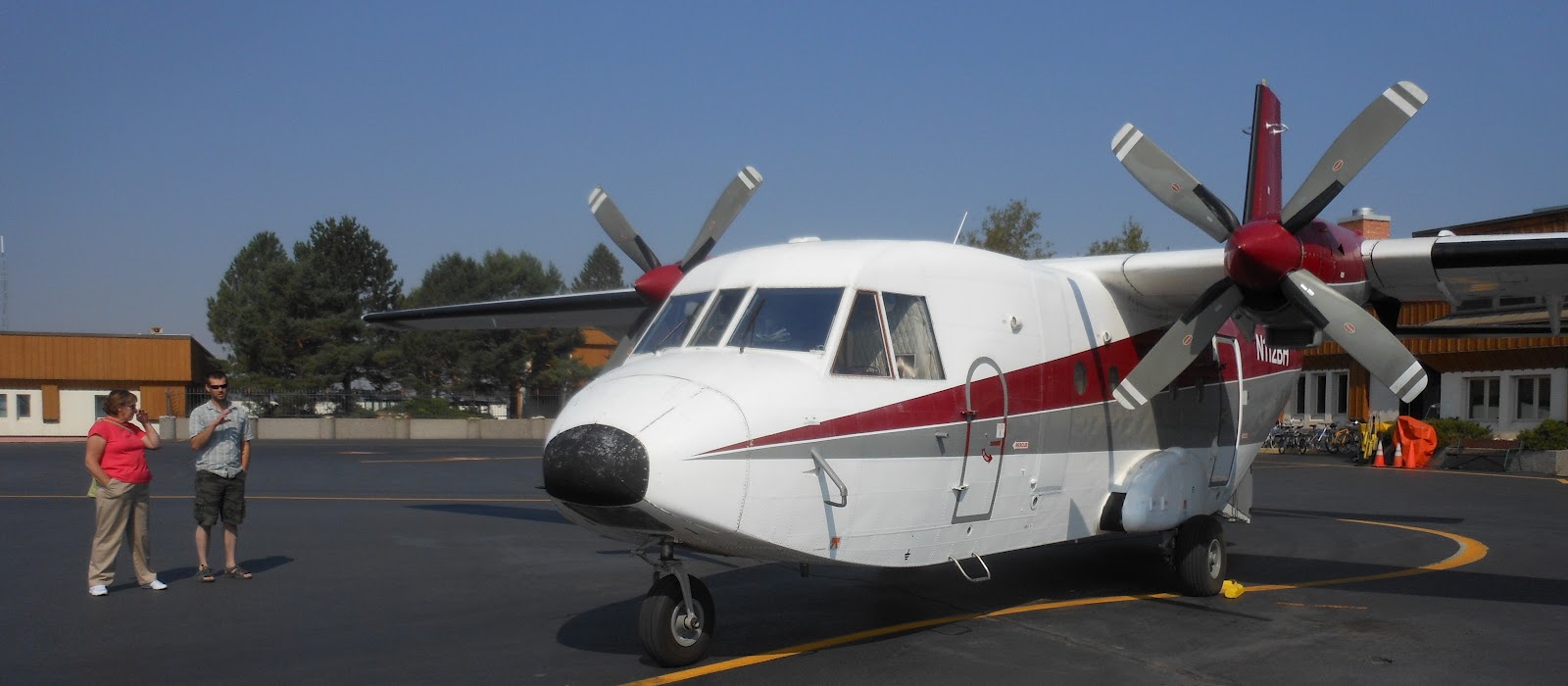
Smokejumpers Center:  Missoula is surrounded by mountains and, since forest fires are routine, this is a good location for firefighting facilities.  The Smokejumpers Center at the Missoula Airport is such a facility and has been in operation since 1942.  With several fires burning and the valley full of smoke, we decided to stop by the center and see what goes on there.  We arrived to find a sign on the door saying it was closed after Labor Day.  As we were about to leave, a guy working inside saw us, unlocked the door and invited us in.  He called Ryan, one of the resident firefighters, who gave us a very informative tour.

In 1910, a series of wildfires burned through 4 million acres of the Pacific Northwest and Rocky Mountains.  Most were in remote areas and there were few roads in those days.  Somebody came up with the idea of parachuting in to suppress small lightning caused fires quickly before they became large fires.  Thirty years later, the first smokejumping organization was established and practice jumps were being made in Winthrop, Washington.  In 1954, President Eisenhower came to Missoula to dedicate the first Aerial Fire Depot.

Today’s smokejumpers are highly skilled professionals.  The Smokejumpers Center provides the training, fitness facilities and dormitories needed by the firefighters.  When they’re not fighting fires, they manufacture their own clothing, repack and repair parachutes, take care of other business and keep themselves in top physical condition. 

Repairing and packing parachutes
Ryan explained that a smokejumper typically carries an 80-100 lb. backpack and another 110 lb. pack is dropped with food, medical supplies, tools and other equipment.  Whatever they don’t use, they have to carry out and, in many cases, roads are not close by.  It’s a lot of heavy work and these guys have to be very dedicated and physically fit.  Ryan also explained the procedures used to decide which fires will be fought and which ones will be allowed to burn naturally.  The politics of personal property and economics have a lot to do with it.  We learned a lot about this profession and were very impressed.
Some of the equipment that goes with the smokejumpers into a fire zone.

Beechcraft 18 cockpit
Museum of Mountain Flying:  We found this small museum tucked away in a hangar at the Missoula airport.  It’s mission is to preserve the legends, lore and historical legacy of the aviation pioneers of the Rocky Mountain West.  It’s a fascinating museum with lots of old photographs, historic documents, and several airplanes.

The centerpiece of the museum is the Mann Gulch DC-3.  This aircraft was involved in a local forest fire disaster.  During a 1949 battle against the Mann Gulch fire, 15 men jumped from this plane to fight the fire.  In this encounter, the fire won and only three of the fire fighters survived.
The Mann Gulch DC-3 (C-47)

National Bison Range:  A small blob on our state highway map showed the location of a “National Bison Range”.  We knew nothing about it, but friends Pat and Glen suggested that we go there . . . so we checked it out.  We packed some snacks and got an early start on the 40 mi. drive north of Missoula.  This wildlife preserve was established in 1908 for the protection of bison (buffalo) and other wildlife.  It’s not heavily promoted as a tourist attraction and we were happy to find very few people there.

After watching an informative video at the visitors center and getting some advice from the ranger, we set out on the 19 mile one-way loop drive through the preserve.

The road was narrow, crooked and gravel with some 10% grades and an elevation gain of about 1,800 ft.  It was a slow but scenic drive (no motorhomes allowed on this road).  At the top of the drive we hiked the Bitterroot Trail and the final half mile or so to the top of the mountain for some nice views of surrounding mountains and smoky valleys far below.
The Bitterroot Trail - National Bison Range
We saw white-tail deer, antelope, birds and lots of buffalo (bison).

A young antelope

Typically, 350-500 head of bison live here.  The bulls weigh around 2,000 lbs.  They are big, fast and can be short-tempered, so we were careful not to invade their “personal space”.  The bison seemed content, but they’re not totally free to roam the 19,000 acre preserve.  The range has to be managed to prevent damage and overgrazing of grasslands, so the bison are occasionally herded from one section of the range to another.

Where the Deer and the Antelope and the Buffalo Roam
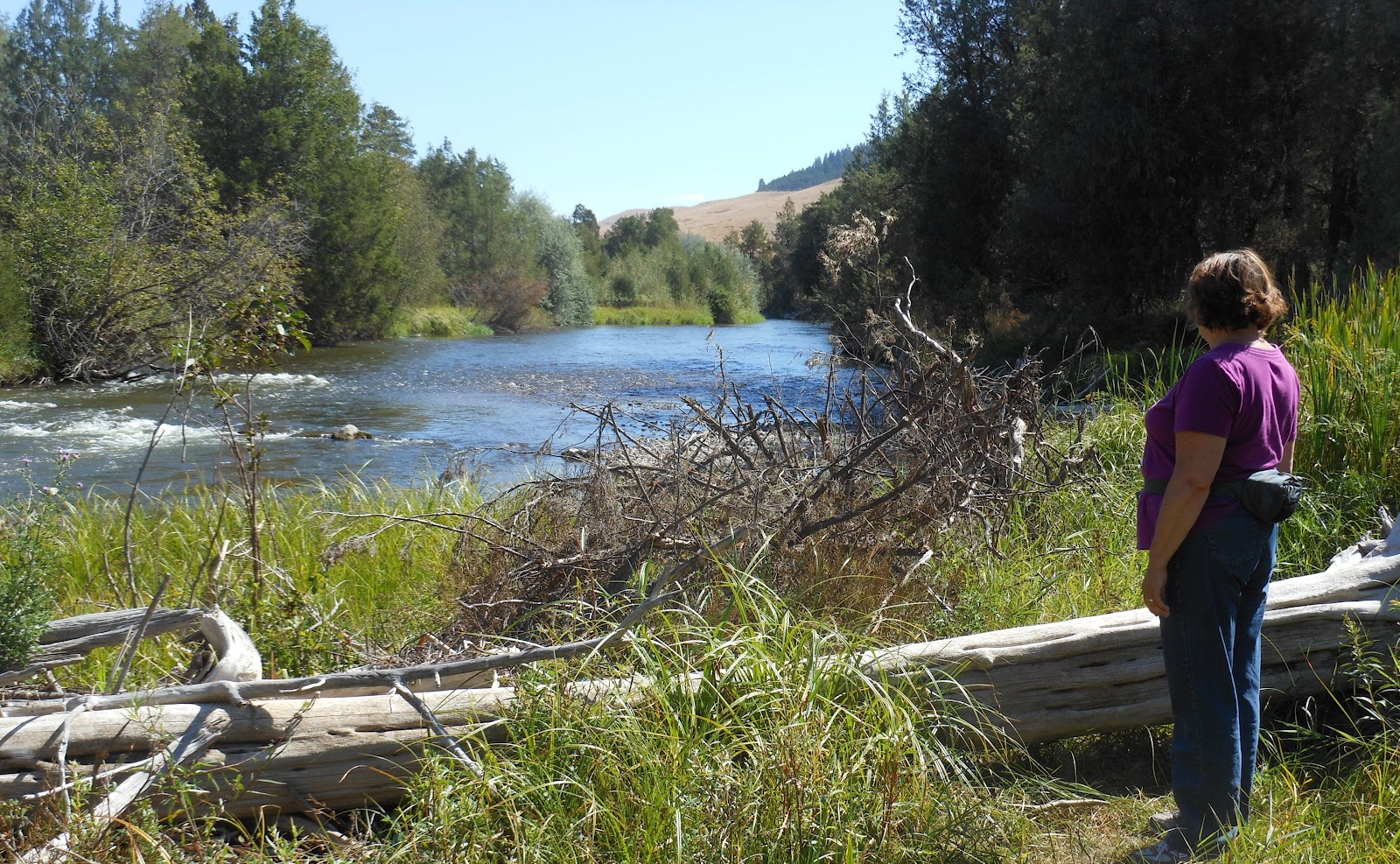
Parts of the bison range include streams and riparian habitat areas.  We spotted a large black bear along Pauline Creek where the berries were most abundant.  Mission Creek (below) passed through the preserve and a large picnic area just outside the preserve.  It was a nice place to close out a very interesting day.

Monday, September 3, 2012

So Much to Do . . . So Little Time

Avalanche Lake Hike:  Our Great Falls connection, Chris and Tracy, suggested that we visit the Avalanche Creek area on the west side of Glacier Park, so we made it a day-trip destination.

The creek is on the Going-to-the-Sun Road, just beyond Lake McDonald, the largest lake in Glacier Park.

McDonald Creek flows into Lake McDonald from the northeast and has some beautiful falls and rapids that are easily viewed from the highway.


We arrived early and nailed down a good parking spot at the trailhead just outside the Avalanche Creek Campground.  From there we walked through the Trail of the Cedars, a beautiful grove of old growth cedar and hemlock trees, to the Avalanche Creek Gorge where the creek flows through a narrow rock channel.  This is low-water season so try to imagine what this might look like during the spring melt.  We'll have to come back another year for that.

The trail followed Avalanche Creek along the gorge and through the cedars for about 2.5 miles.  It was slightly uphill most of the way but the trail was pretty good (and very popular).

We noticed two important things during this hike; (1) there was absolutely no litter anywhere and (2) other hikers were very friendly.  Nearly everyone we passed had a smile and a "Hi".


Bonnie found a nice hollow log for a brief rest along the trail.


It was a great relief, especially to our burning feet, to finally arrive at Avalanche Lake.  Tucked away in a steep valley surrounded by mountains, this pretty little lake was our ultimate getaway.  There were no roads, no traffic noise, no electricity, no houses or mini-markets, etc.  But, thanks to modern technology, it was not beyond cell phone range.

Avalanche Lake looking northwest toward Heavens Peak
Ice cold water, so clear it didn't look like water at all.
We hiked to the far end of the lake, extending our total hike to about six miles, which was well beyond our "normal" range of about six city blocks.  Our feet burned and muscles ached, but it was worth every painful step.

As we got down to lower elevations, we were able to slow our pace and find a nice log to sit on while cooling our tennies in Avalanche Creek.  Very refreshing!

We spent several very nice days in Glacier Park this summer, but it was time to say "Good-bye" and continue on.  We'll be back agian.

Whitefish:  The Great Northern Railway was once the center of activity in Whitefish.  It built a beautiful large depot and operated a major maintenance facility and roundhouse.  Today, the Great Northern is long gone, replaced by the Burlington Northern Santa Fe (BNSF) and most of the old rail facilities sit idle.  Since the railroad's priority was freight, it had little need for the depot and was considering tearing it down.  Fortunately, the Whitefish Historical Society stepped forward and arranged to buy the old building for $1.  Today, it remains a central attraction, adjacent to Depot Park, and still serves traveling rail passengers (AMTRAK).  The historical society established a very nice railroad and history museum in one corner of the depot where the freight office used to be.  Ron spent at least an hour chatting about local railroad history with a couple museum docents who were more elderly than he, and had seen it all.

About a half mile from our RV park is the "famous" Blue Moon Bar & Grill.  This place has been here since the late 1940s.  It offers great food, live music and dancing and even a live rodeo once a week.  The Blue Moon caught Ron's attention with its sign advertising "Beer and Burger for $7".  The food was excellent, so we returned for Friday night "Prime Rib" and it too was excellent.  Bonnie says it's the best prime rib she ever had.  It's true . . . you can't judge a book by its cover.

Whitefish City Beach is a popular place in the summertime.  Parking is very limited, so late arrivals either walk a long distance or go elsewhere.  It's a beautiful lake and very nice little City park.
City Beach on Whitefish Lake
Whitefish Lake
Bigfork:  The Labor Day weekend began with the "Rumble by the Bay" car show in the small town of Bigfork on Flathead Lake.  Bigfork (pop. 1,400) hasn't grown much over the years, but has transformed itself into a tourist town of world-class art galleries, fine dining and live theater.  It's impressive that a town of this size has 50 shops, 25 restaurants and 16 art galleries.

1951 Hudson Hornet
We had lunch and browsed through several shops and galleries, but our primary mission was the car show.  It was a good one with more than 300 cars lining the downtown streets.

Every hour, on the hour, all the cars with loud pipes were directed to start their engines and rev them up at the same time to create the "rumble" . . . and it certainly was.


September has finally arrived and it's feeling more and more like fall.  Schools are back in session, tourists are folding up their tents and heading home, and our little RV park now has a few vacant spaces. 

Today is Labor Day.  We thought it would be a big deal, but not around here.  There are no parades, no fireworks and even the swap meet at the local drive-in theater has wrapped up its season.  The only "special event" we could find was a Labor Day Inventory Reduction Sale at a mattress store.

That concludes our two weeks in the Whitefish/Kalispell area.  We probably said it before, but we'll say it again . . . "We love this part of the country."

We'll sign off with a photo of Brown Mountain on the south side of Avalanche Lake.  A few days after our hike, lightening struck  and touched off a forest fire in this area.  The Avalanche Lake trail is currently closed while the fire burns.  We hope the fire will be contained before it destroys much of this beautiful landscape.
Brown Mountain at Avalanche Lake